Monday, September 22, 2014

1936--The Great Ziegfeld, Robert Z. Leonard

1936--The Great Ziegfeld, Robert Z. Leonard
Nominated: Anthony Adverse, Dodsworth, Libeled Lady, Mr. Deeds Goes to Town, Romeo and Juliet, San Fransisco, The Story of Louis Pasteur, A Tale of Two Cities, Three Smart Girls
Should have won: Modern Times
Be sure to see: The Golem, My Man Godfrey, Popeye the Sailor Meets Sinbad the Sailor, Sweeney Todd, The Demon Barber of Fleet Street
"I've seen the flies on the flypaper and it seems to me they stick very well,"--Anna Helm

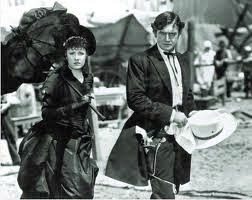
     At the 1893 Chicago World's Fair, Florenz Ziegfeld  is promoting the world's strongest man (right across from a belly dancer named Little Egypt who is billed as the 8th wonder of the world; I guess she didn't watch King Kong three years earlier). His rival, Billings (played by the Great and Powerful Oz himself, Frank Morgan), owns the Little Egypt act. Billings tells Ziegfeld he intends to sign French actress Anna Helm but Ziegfeld wants her to join his act. Ziegfeld devises a plan that will include numerous beautuful women (it is no secret Ziegfeld is a ladies man) and calls it the Ziegfeld Follies. Many acts besides the women take place including an amusing number by a stagehand played by, Ray Bolger, who plays himself in this movie. You might remember him as the scarecrow in The Wizard of Oz.  Things seem to go well, and then the stock market crash occurs. 

     The Great Ziegfeld is an intereging movie because it isn't a musical but it could have been. When I watch a traditional musical, the other storylines are just filler until the next dance sequence starts; in this film, the musical numbers drag it slightly. I cared more about Zieglfeld and his relationships with his acts or rival. Some of the musical acts are good though, particuarly the dance with all the girls and the collies and ponies (though some of the dancing is a little sloppy and not polished) and I especially enjoyed Ray Bolger's tapdance. He does the splits in a way that seems impossible. He is not' the best dancer I've ever seen but might possibly be the fastest. I found it funny he says to Ziegfeld that he's been a prop boy for five years and wants to tap because his heart isn't in sweeping. Three years later he would be asking the Wizard of Oz for a brain. Another act is one of those blackface racist acts called“If you knew Susie” ala Al Jolson. 

     It is an interesting movie because it is true. Like any true story, the movie takes on liberties but there really was a Florenze Ziegfled and he really did put on the follies. But his place of death is changed. I didn't mind because most movies need to change some aspects of true stories for dramatic purposes. And on top of that, I wasn't familiar with the backstory anyway. .

     My favorite performance is certainly William Powell as Ziegfeld but Luise Rainer won the Oscar for her portrayal of Anna Held. She would also nab the award the following year for The Good Earth and was the only actress to win two years in a row until Katherine Hepburn won in 1967 and '68. It should also be noted that, as this review is being posted, she is still alive at age 104. I like Ziegfeld's character though. Even after a downfall, he overhears men in the barber shop talking about how his shows stink, not knowing he was there the whole time. He then becomes determined to have four hits on Broadway.

     The Great Ziegfeld was okay. Enjoying the non-musical acts more than the musical ones sort of kill the mood for a movie like this, but it worked in a sense. It was way too long though. Some of the dialogue sound as if the Marx Brothers had written it. “Do you realize you gave me five pounds?” “Yes I'm trying to lose weight” or “This cheese is so strong it could walk over and say hello to your coffee” “Well it had better not, this coffee's too weak to answer it.” Leave that stuff up to Chico and Groucho, it didn't work here.

     The final line in the film, when Zieglfeld's health is declining, sums up his character perfectly. “I've got to have more steps. I need more steps. I've got to get higher. Higher.” Even at his lowest point she showman in him shines through. The movie is pretty decent but nothing to shout about. The actor who played Florenz Ziegfeld is William Powell and if you'd like to see him in an amusing comedy, watch My Man Godfrey made the same year.


Wednesday, September 17, 2014

1935--Mutiny on the Bounty, Frank Lloyd


1935--Mutiny on the Bounty, Frank Lloyd

Nominated: Alice Adams, Broadway Melody of 1936, Captain Blood, David Copperfield, The Informer, The Lives of a Bengal Lancer, A Midsummer Night's Dream, Let Miserables, Naughty Marietta, Ruggles of Red Gap, Top Hat

Should Have Won: Bride of Frankenstein
Be sure to see: Buccaneer Bunny (1948 cartoon), A Night at the Opera, The 39 Steps, Werewolf of London
 "He doesn't punish men for discipline; he likes to see men crawl," --Lt. Fletcher Christian

    Mutiny on the Bounty is an engaging movie, and every second the Bounty is at sea, the audience feels terrified for the men. Not from storms or lack of supplies, but from their captain. The captain of the Bounty is William Bligh, one of the meanest, nastiest, cruelest sons of bitches in movie history. Can he be classified as a villain if he is just doing his job of leading the ship? I'd say so. And as much as I hate remakes, this is one which I'd like to see modernized versions. It was remade in 1962 with Trevor Howard in Bligh's role and Marlon Brando as  Christian and again in 1984 with Mel Gibson and Anthony Hopkins known simply as The Bounty. I haven't seen either remake but I can imagine a successful version coming out today. Unfortunately, the writer would throw in too many comic relief lines and the director would undoubtedly edit a million cuts into it, distracting the characters and story.
 
    It is the winter of 1787 and the Bounty has left from Portsmouth Harbor to Tahiti to procure breadfruit trees for transplanting to the West Indies as cheap food for slaves. Lt. Fletcher Christian is recruiting men for the voyage and they seem up to it until it is revealed Bligh will be captain. On the journey Bligh punishes men for no good reason. He sends one man up to the top of the mast in a storm. When Christian brings him down, Bligh sends him right back up. When a man complains about his knees scraping from washing the deck, Bligh ties him to a rope and drops him deep into the ocean until he drowns. Another man accidentally falls overboard so he is flogged. One man is even flogged to death. Because he died before the lashes were completed, Bligh orders his man to continue whipping the corpse until all the lashes are totaled.

    There is a big sequence in the middle of the film when the ship reaches Tahiti and the men are allowed to go to shore, yet still ordered to work. I suppose there are some important plot points during the time on the island but all that matters is the hellish journey that, thinking back on the film, appeared to be voluntary. It makes me wonder why these men signed up. I don't recall any mention of payment.

    Christian sees men chained below the deck and has had enough. He forms a mutiny against Bligh to send him afloat with a few men who do not wish to take part. Some of the men would rather see Bligh dead or whipped, but Christian will not see to that, even knowing mutiny will cause him to suffer great consequences later. 
 
    I've seen Clark Gable in only three movies and all three are best picture winners (Gone With the Wind and It Happened One Night are the others). Both he and Charles Laughton were nominated for best actor in their respected roles for this film. Both lost to Victor McLaglen in The Informer. I recommend seeing this movie once. Once is enough. It is pretty good and watching the slimy tyrant Captain Bligh is entertaining. But the best thing I can say about this movie is it inspired one of the greatest cartoons of all time. Take a look at the Bugs Bunny classic Buccaneer Bunny from 1948. Bugs becomes Captain Bligh for a scene to trick Yosemite Sam. It is very funny and has tons of cannon-fire in Sam's face; and the classic steps to the four doors bit is one of the biggest laughs in cartoon history. 
 
   But more importantly, this film was directed by Frank Lloyd and it should be noted his movies won best picture two of the past three years as he was also in the director's chair for Cavalcade two years prior.

Monday, September 15, 2014

1934--It Happened One Night, Frank Capra


1934--It Happened One Night, Frank Capra
Nominated: The Barrets of Wimpole Street, Cleopatra, Flirtation Walk, The Gay Divorcee, Here Comes the Navy, The House of Rothschild, Imitation of Life, One Night of Love, The Thin Man, Viva Villa!, The White Parade
Should have won: It Happened One Night
Be sure to see: The Man Who Knew Too Much
"Why didn't you take off all your clothes? You'd have stopped 40 cars."--Peter Warne
 
     It Happened One Night is the first of only a trio of movies to win the big five at the Oscars: Best Picture, director, actor, actress, and screenplay. 1975's One Flew Over the Cuckoo's Nest and 1991's The Silence of the Lambs would match it. It has been described by the film's producer as a screwball comedy romance. 

    When Ellie Andrews weds a mercenary, her rich father takes her away on the family yacht. Ellie leaps overboard to join her husband but on the way runs across the suave (and recently fired reporter) Peter Warne. As the two hitchhike they find they've fallen in love. 
 
    I think what makes this film so enjoyable is both the circumstance and the dialogue are involving. The couple's journey flows from one obstacle to the next; from a bus to hitchhiking to staying in cottages. All the while, Peter's smart alack wit in response to Ellie's suggestions are amusing. He calls her brat because, perhaps, that is what she has always been, being born into a rich family. Her father has reported her missing and her picture is in the paper. One of my favorite subplots in the film is Shaffer. He is a passenger on the bus who recognizes her from all the missing girl pictures in the papers. The confrontation he has with Peter about the reward money for turning her in is a high part in the film for me. 

    No doubt, the most famous scene in the movie is when Peter teaches Ellie his various ways of hitchhiking (which don't work) and Ellie teaching Peter her way (which does). At first Ellie is in a hurry to get back to New York but eventually she enjoys his company. I liked how Peter acts a gentleman one minute (putting up the “walls of Jericho”) and threatens her ala Ralph Kramden to Alice the next. 

    It Happened One Night is one of the best Oscar winners I've seen just because it is so enjoyable. It isn't very complicated or have a deep script. It is also a little sloppy because I spotted a number of editing flaws. But it was a great example of a solid romantic comedy. And Claudette Andrews' acceptance speech of “Thank you. I owe this to Frank Capra” has to be the second shortest acceptance speech in history to Joe Pesci's Goodfellas win. Do yourself a favor and youtube that one.

Thursday, September 11, 2014

1933--Cavalcade, Frank Lloyd

Image result for cavalcade 1933

1933--Cavalcade, Frank Lloyd
Nominated: A Farewell to Arms, 42nd Street, I am a Fugitive from a Chain Gang, Lady for a Day, Little Women, The Private Life of Henry VIII, She Done Him Wrong, Smilin' Through, State Fair
Should have won: King Kong
Be sure to see: Duck Soup, The Invisible Man
“Let us drink to our sons who made part of the pattern and to our hearts that died with them. Let us drink to the spirit of gallantry and courage that made a strange heaven out of unbelievable hell.”--Jane Marryot

 
    One of the greatest movies ever made—and will ever be made—was released in 1933. The timeless wonder of King Kong, the best monster movie of all time, will last for eternity. To watch Cavalcade and see it took home the best picture Oscar leads me to believe the early years of the Academy were a little unfocused. I wouldn't say that Cavalcade is a mess but it is certainly forgettable.

    As 1899 comes to a close, England and Boers are at war in South Africa. A London family awaits the cavalcade of the 20th century. The movie follows the Marryot family, starting with the husband, Robert, getting ready to ship off to war. I've seen a lot of movies where someone leaves for war and the soldiers are typically young upbeat men with a twinkle in their eye. Robert is a proper gentleman in a tuxedo.

   Time passes; it is 1909 and a man is making sand art of various figures of England...and Theodore Roosevelt. There are some nods at the war and also at the sinking of the Titanic when 1912 rolls around. This is one of my favorite scenes because, though it is capped with the nod to the doomed vessel, the conversation leading to it is mysterious and heartfelt. A couple is discussing a honeymoon and other topics like the depths of the Atlantic, their future together, and even death. But it is done in a caring way so we connect with the couple, then we see the name of the ship they are aboard and our hearts sink, no pun intended. 

    Different characters come in and out and there is a a musical number. I love musicals so usually I would enjoy a musical number. In this case, the women were singing over each other with no harmony or cohesive lyrics. I believe the song might have been intended to be a novelty act but it was just annoying to me. 
   
    When the war does hit, the sequence is shown in very effective overlapping shots. This movie is definitely an event-driven story rather than a character-driven one. I didn't care about most of the characters but it was nice to see Una O'Conner in it. You might recognize her from her roles in Bride of Frankenstein and The Invisible Man with her unmistakably obnoxious accent. 

     The movie isn't too bad but is extremely unfocused and ultimately forgettable, as mentioned. I would not recommend Cavalcade unless you are a completist. Early on Robert tells his wife, Jane to give the future a chance. I wonder if that is what the members of the young Academy, in only its sixth year, were telling each other, too. The future turns out to be pretty bright though; the 1930s best pictures end up to be very strong.

Monday, September 8, 2014

1932--Grand Hotel, Edmund Goulding


1932--Grand Hotel, Edmund Goulding
Nominated: Arrowsmith, Bad Girl, The Champ, Five Star Final, One Hour With You, Shanghai Express, The Smiling Lieutenant 
Should have won: Freaks 
Be sure to see:Horse Feathers, The Mummy, Scarface the Shame of a Nation
“Grand hotel. Always the same. People coming. People going. Nothing ever happens.”--Dr. Otternschlag

      In what was considered the greatest ensemble cast of its time, Grand Hotel is a film based on a play which was based on a novel by a former chambermaid. The hotel is always busy with people buzzing about, the camera using some impressive tracking shots following one patron to the next. 
 
     The hotel's manager, Preysing, hires a stenographer assistant, Flaemmchen, who would rather be an actress. There is a fight between Preysing and Krigelein, an older man who is in bad health and might be dying, over Krigeliein's dancing with Flaemmchen, keeping her from her tasks. One guest of the hotel is a famous ballerina played by Gretta Garbo who (in a famous line) just wants to be left alone. One night while she is in her room holding a bottle of pills and talking to herself about wanting to end it all, a would-be jewel thief hiding there approaches from the dark. Rather than being scared she is attracted to him. 
 
     There is another fight. There is a murder by telephone...literally. I won't reveal who is guilty or who the deceased is. I'll just say that there was a lot of stuff going on in this film. Two things I did admire were the music and the camera work. There was music playing in the background virtually the entire film. It reminded me a little of American Graffiti how there is a song on the soundtrack practically every second except for the goat killer scene. What I found interesting in Grand Hotel is when the music does stop about an hour and forty minutes in I thought “Huh, the music stopped” and a character in the film says “The music stopped.” I guess we were on the same wavelength. But what I enjoyed most is the swooping camera work. And Preysing is kind of interesting. He is tough, hard-nosed man shown during his fight or how he orders people about. Other times he seems to care about people such as after a card game when Krigelein wins 14,000 marks. Krigelein gets drunk and drops his wallet which Preysing pockets. When Krigelein realizes he's lost it and says he has nothing else in the world, Preysing seems to find a heart. 
 
     Unfortunately I wasn't overly impressed with the movie itself other than that. But some of the behind the scenes tidbits are interesting. Wallace Beery didn’t even want the role until the producer Irving Thalberg assured him he would be the only person in the film using a German accent. After the premier (which was a huge hit) Greta Garbo was supposed to address the crowd. Instead, Wallace Beery came out in full drag and said the line. The gag flopped. All in all the movie is forgettable and I don't recommend it but it does have one bit of trivia that might be the most interesting in Oscar history: Grand Hotel is the only best picture winner to not be nominated in a single other category. One nomination; one win; best picture. You would be better off watching Freaks, the movie that was banned in England for 20 years.  But as a whole, Dr. Otternschlag is correct, nothing really happens.


Thursday, September 4, 2014

1931--Cimarron, Wesley Ruggles


1931--Cimarron, Wesley Ruggles
Nominated: East Lynne, The Front Page, Skippy, Trader Horn
Should Have Won: Frankenstein
Be sure to see: City Lights, Dracula, M, Monkey Business
“If we all took root and squatted, there'd never be any new country."--Yancy Cravat

      I love old movies. Most of the people who don't appreciate them, I assume, feel they are dated. Most of the time I feel that is part of their charm and don't even notice. Westerns often feel dated because, well, they are dated. Even at the time of their release they are dated because they are set in the past. I've never let that bother me. Cimarron, on the other hand, feels extremely dated, from the poor sound quality to the blatant racism. But on a vast visual scale, the movie's sets do look very good. 

    The movie spans forty years, beginning in 1889. President Harrison has opened Indian Oklahoma for white settlement (that was mighty neighborly of him) leaving 2 million acres free for the taking. Hundreds, perhaps thousands, of covered wagons are all packed together and a man with a watch and gun performs a modern day track and field sprinters' take your mark; get set; go! and everyone takes off at blinding speed. I guess these guys didn't play Oregon Trail in elementary school. 

     Cimarron (the place not the movie) is savage country; wild and unruly. Yancy Cravat and his wife Sabra decide to set out and try the new land; start a new life opening up newspaper in a new town. Yancy, Sabra, their son Sim (short for Cimarron) head west. Little do they know their black servant's son Isaiah has stowed away in their sleeping bag. Isaiah is an interesting character because the Cravats seem to love him more than the filmmakers do. They treat him as their own. But some very racist dialogue is thrown his way in such a casual fashion the audience was supposed to accept it; this was the early '30s after all. Pay no mind to the jaw dropping watermelon wagon scene (it makes Isaiah glad to be in Oklahomey). Not to mention Yancy's stuttering coworker (a stereotypical Jewish man) saying “C-c-come on, colored boy” to Isaiah. On top of the Isaiah and Jewish characters, the Native Americans are stereotyped characters. I don't have a problem with any of this because that was the time and I'm not one to get offended by history. It is the way the movie was filmed and should not be changed. Censorship is evil, I always say.  I just figured I'd throw out a warning for anyone wishing to pick the movie up. 
  
     Yancy, with his prominent jawline and wild hair (he looked like Anton Chigurgh from No Country for Old Men) runs into some rough characters when he reaches his new town. They shoot off his hat and bully street peddlers. Yancy never backs down though, and everyone seems to have known him for years. On top of being the local newsman he is also a preacher and has his final run in with the roughens. This happens halfway through the movie which surprised me since I thought that was going to be the climax. Throughout the movie, Yancy is a newsman, sheriff, and a preacher. He preaches church service for nine different denominations. Right over his shoulder during his sermon is a picture of a woman in bed that says “Open all day and all night”. That sure seemed out of place.

     The years pass. Children are born. The newspaper lives on. And since this is a western, there must be a shootout and there is a doozy, with one surprising and sad casualty. No it isn’t Lou Hefner the local wall-
paper salesman, though he does have the best name in town. Perhaps his great, great, grandson should start a magazine.
 
     As time passes, Yancy disappears leaving Sabra to run the newspaper. After forty years she earns an award which is a pretty big deal since women don't usually run a paper. What I liked about this scene is its time in the move is 1929 which is about the same time the movie was released, perhaps when it was written. It seemed appropriate. Their son has grown to marry an Indian woman and their daughter is upstanding too, but Yancy hasn't been seen in years. But the movie offers us two surprises at the end, an unveiling of a statue  (of what? They really drag this scene out) and the answer of what has become of Yancy. 
 
     I can understand why Cimaron was nominated for best picture. It was a pretty grand scale of a film and I liked a lot of the messages. I would love to see more movies with lead actor Richard Dix (Dick Dix, huh? He should have stuck with his birth name Ernst Brimmer). Perhaps his performance in the silent version of The Ten Commandments eight years earlier is worth a look. I bet he was great on stage because of his booming voice. But the movie Frankenstein, the actor Boris Karloff as the monster, and the screenplay adapted from Mary Shelly's novel should have all won the Oscar that year...none were even nominated.

Monday, September 1, 2014

1930--All Quiet on the Western Front, Lewis Milestone

1930--All Quiet on the Western Front, Lewis Milestone
Nominated: The Big House, Disraeli, The Divorcee, The Love Parade
Should have won: All Quiet on the Western Front
Be sure to see: Animal Crackers
"We live in the trenches out here. We fight. We try not to be killed, but sometimes we are. That's all."--Paul Baumer

     Early on in the Academy Awards' history it seemed war movies tended to pull at the voters' heartstrings. Wings had been a solid outing but All Quiet on the Western Front, based on Erich Maria Remarque's novel, provides an intensity that Wings didn't produce. It follows a group of young recruits in Germany during World War I who are thrown into intense warfare. One by one, each faces his ultimate demise.

   For years I had said Full Metal Jacket is the best war movie I have ever seen. This changed when I picked up All Quiet on the Western Front. So many elements in this movie are powerful. The tracking shots during the attacks are brilliant. The camera gets the audience right in with the soldiers as though we were running across the fields with the men, dodging the explosions like we were in danger as well.

     One particular death (I call it the fence scene) is among the greatest and most shocking death scenes of all time. I was blindsided by it; especially considering how long ago this movie was made that it passed the censors. But the two best scenes are not during intense battle. One is the ending which matches a beautiful moment and a deadly one. But the best scene for me is in a trench when a recruit stabs a Frenchman and then apologizes to the corpse for what he has done. The agony he feels for this man and his family and some of the words he speaks are powerful moments. 

      I've read that some of the scenes were considered so realistic they were used in actual documentaries about war. The ending offers a subtle image and message about finding beauty among chaos, even if it results in tragedy. All Quiet on the Western Front is certainly the best winner in the first decade of the Oscars. A must for fans of war movies. By the way, it was remade in 1979 with the always reliable Ernest Borgnine.