Monday, January 12, 2015

1968--Oliver!, Carol Reed

 
1968—Oliver!--Carol Reed
Nominated: Funny Girl, The Lion in Winter, Rachel Rachel, Romeo and Juliet
Should have won: Rosemary's Baby
Be sure to see: Bullitt, Night of the Living Dead, Once Upon a Time in the West, Planet of the Apes, Therese and Isabelle, 2001: A Space Odyssey
“If we get enough work out of him without putting too much food into him then we'll keep him”--Mr. Salsury

     1939 is generally considered the greatest year of all time for movies, but 1968 is surly in the running. And with titles like Rosemary's Baby, Planet of the Apes, Night of the Living Dead, Bullitt, Once Upon a Time in the West (possibly the best western of all time), and 2001: A Space Odyssey (horribly overrated and boring for my taste but its reputation gives it respect to include here), Oliver! taking home the Oscar has to be one of the biggest “What was the Academy thinking?” moments of all time, though 1996, 2001, and 2005's winners take top honors for me.

    Oliver! is a musical based on Oliver Twist. It tells the story of a boy who goes from an orphanage to a stint with a pack of child pickpockets. Oliver is kidnapped by Bill Sikes, played by Oliver Reed who I know more from the Curse of the Werewolf. Sikes is a pretty menacing villain which is one of the things that keep the movie afloat. Every movie, even bad ones, need a good antagonist. Not to say the movie is bad, it has its moments. But I believe the movie belongs to two of the boys. Oliver, of course, played by Mark Lester who is actually a decent singer and pulled off the “pitiful orphan” quite well. Another kid named Dodger is more experienced as a pickpocket troublemaker than our title character and drives his scenes pretty well.

     Two dance numbers stood out, “Who will buy these wonderful roses?” and “Consider yourself”. Both are large ensemble numbers but other than those, none are really memorable. Plus the movie is very long and if the movie is great, length doesn't bother me, The Sound of Music, Schindler's List, etc. I really didn't care about any of the characters in the movie other than Oliver. I didn't even care about one character who suffers a rather frightening death at the hands of Bill. It was cute in parts and pretty well crafted but to win in such a solid year is pushing it. The true best picture want even nominated. Perhaps I recommend giving Oliver! a look but the statue should have gone to the snubbed Rosemary's Baby, one of the greatest movies ever made and the best movie of the 1960s. 


Friday, January 9, 2015

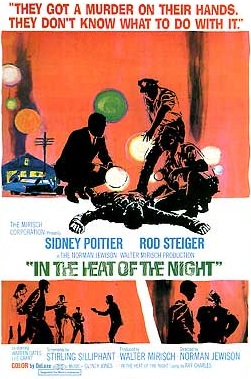
1967--In the Heat of the Night, Norman Jewison

 Image result for in the heat of the night movie

1967--In the Heat of the Night—Norman Jewison
Nominated: Bonnie and Clyde, Dr. Doolittle, The Graduate, Guess Who's Coming to Dinner
Should have won: Bonnie and Clyde
Be sure to see: Cool Hand Luke,Wait Until Dark
“What do you mean I'm holding the wrong man? I got the motive which is money and the body which is dead!”--Bill Gillespie

     In the Heat of the Night caught my attention immediately with the visual of the train and Ray Charles' voice singing the theme. I loved this movie and one of the main reasons is the music, in particular, the score written specifically for the screen by Quincy Jones. No piece of music had already existed; every bar of music was original.

     It is a hot night in the racially tense Sparta, Mississippi, and an officer on patrol discovers a body in the street. Doing rounds in the area looking for suspects he finds a black man waiting for the 4:05 train to Memphis and arrests him as a suspect. Upon returning to the station it is revealed the man is Virgil Tibbs, Philadelphia's number one homicide expert who is in Mississippi visiting his mother. After his identity is cleared he is free to go. But when a suspect the police is positive is the killer is arrested, Tibbs uses his intellect and experience to prove the man's innocence. Rather than going home, he stays and takes the case.

     I loved every moment of this movie. Sydney Poitier is a very commanding presence. Rod Steiger rightfully won the Oscar for his performance as Bill Gillespie. His character is constantly chewing gum (it is reputed Steiger chewed 263 packs of gum during filming) examining the situations. He probably knows (but won't admit) he isn't as smart as Tibbs. He is also thankful to have someone as capable as Tibbs on his side but at the same time is concerned about his presence. The people of Sparta aren't too keen on the idea of a capable black man in town, much less running the ship, as when Gillespie saves Tibbs from a group of white men who have him cornered. I love the climax of this scene. When one of the men states what is on his mind, Gillespie slaps him around, then moves on to the next one.

     The movie was very popular with black audiences because of Tibbs and though he has many key moments the one that seems to stand out has to be “the slap heard around the world.” Tibbs finds a plant in the victim's car so he and Gillespie go to Mr. Alvacot's greenhouse. Tibbs questions Alvacot on the case and gets slapped. He immediately slaps Alvacot back. Alvacot is stunned but so is Gillespie, even when Alvacot asked what will be done about it. In 1967, it was a very powerful moment to see Tibbs strike a white man. I, of course, thought of the moment in Night of the Living Dead the following year when Ben strikes Barbara.If you've seen it, you understand.

     Who actually committed the murder, the motive, the location of where the murder took place compared to where the body ended up, and other instances in the case seem to be secondary to the performances and the racial tension. In the Heat of the Night is one of the best detective movies I've seen and though Poitier drives the film, my favorite aspect is Steiger as Gillespie. But I must say whenever he was on screen I couldn't help but picture Carroll O'Connor in his role from the television show.

     In the Heat of the Night is completely worthy of a best picture nomination, but Bonnie and Clyde is a monumentally superior cops vs. bad guys movie. By far the correct choice for what should have won the Oscar. I wonder if it was one of those cases where the award "had to" go to Heat. Just a theory but it is still very good and worth a look.

Image result for in the heat of the night movie

1966--A Man For All Seasons


1966--A Man for All Seasons—Fred Zinnemann
Nominated: Alfie, The Russians are Coming The Russians are Coming, The Sand Pebbles, Who's Afraid of Virginia Woolf?
Should have won:The Good the Bad and the Ugly
Be sure to see: Fahrenheit 451
“It is a bad sign when people are oppressed by their good fortune.”--Cromwell

    King Henry VIII wishes to divorce his wife, so that he may marry another. Thomas More, England's Roman Catholic Chancellor, opposes this and feels the church would look down on the king. King Henry is outraged at this and tries to attack More through the courts. So More resigns for a private life. Because More's resignation speaks so loudly (referred to in the line by the prosecutor “Silence can, under the circumstances, speak”) of his thoughts on the king, the king demands More's approval of the divorce. More, however, refuses to give in despite imprisonment and possible beheading.

    At least that's what I gathered. I've heard so many good things about this movie and this was the first of the best picture viewings where I felt I had my work cut out for me. Even others I didn't enjoy I could still follow. Even my notes I had taken on this one were scattered and unfocused. My favorite moments were the scenes of More before the judges, both the big court scene at the end and the one in front of the the three judges. His dialogue was sharp and focused, flustering the judges. I found it interesting More is on trial for keeping silent where, today in the United States, we have the right to remain silent.

    Typically when a story loses me I focus on other aspects of the film. The sets were great and seeing Robert Shaw playing the king was certainly different. I'd seen him as the rugged old salt in Jaws and the sneaky mob boss in The Sting (another best picture winner). I also thought it was neat the first lines are spoken over six minutes after the start of the film. Rio Bravo, There Will be Blood and The Good the Bad and the Ugly are other movies where the first lines are held off for a while. But that is not to say the movie was bad. It has a great message and technically had a lot going for it, I was just a little bored. It certainly made me glad to live in a democracy.


Thursday, January 1, 2015

1965--The Sound of Music, Robert Wise


1965--The Sound of Music, Robert Wise
Nominated: Darling, Dr. Zhivago, Ship of Fools, A Thousand Clowns
Should have won: The Sound of Music
Be sure to see: Color me Blood Red, Repulsion
“When you know what notes to sing, you can sing most anything,”--Maria 
     There are many great movies out there but a handful that are simply a delight every time I see them. The Sound of Music is certainly one of them. I would put it third on my favorite musical list behind The Blues Brothers and Singin' in the Rain but there is a difference between “favorite” and “greatest” which I've tried to explain to people for years. I've seen The Sound of Music three times and I've been lucky enough to have two of those times in the theater. Plain and simply, it is one of the best movie-watching experiences I've ever had. 
     The film opens with a series of beautifully photographed areal shots of the countryside before zooming in on Maria, a pretty young nun, singing the title number. We soon find, in a musical number by the nuns, Maria means well but has her problems. It should be noted that of the 11 songs in the movie, this song called “Maria” (“How do you solve a problem like Maria” not to be confused with the one in West Side Story) and “Climb Every Mountain” are the only songs I didn't like. Actually, “Climb Every Mountain” was sung a couple of times, I didn't care for it either time. And in a wedding scene the nuns sing “How do you solve a problem like Maria” which was out of place to call a bride a problem on her wedding day; plus there was a line I didn't understand. I could have sworn they sing something about a bullet in her head; I didn't hear that line the other times they sang it. In fact there were three lines in this movie that I misunderstood as something obscene or out of place, one of which I know is just a misunderstanding and that is “What is it you can't face?” But the bullet line left me scratching my head and I could swear (and I've heard from others who hear this line too) at the beginning of the second act Max calls the kids a bunch of gloomy pussies. If I am not mistaken, and he really said that, then that is officially my all time favorite movie line. 
     But because I like ranking things I'd say my top three are “Sixteen going on seventeen”, “The Lonely Goat herder” (sung in a very clever puppet show), and “Do Re Mi” which, in my mind, is one of the greatest songs I've ever heard, and certainly my favorite in this movie. It is sung a few times in the movie, but when Maria and the children are in the meadow and then riding bikes and singing it, it is by far my favorite scene; one of my all time favorite scenes in fact. I find the song to be a brilliant teaching tool to someone learning music. When the scene ended I wished the projectionist had rewound the film so I could see it again.
   Gaylord Von Trappe, an Austrian naval hero, leaves for Vienna and needs a governess for his seven children, ages ranging from 5 to 16 (going on 17). The abbey sends Maria to be the new governess and she finds she is the twelfth governess the children have had. Von Trappe runs his house with an iron fist, using whistles, treating his children like soldiers instead of his offspring, and expects Maria to do the same. She will have nothing of it and, after finding the children aren't allowed to sing, play, or, well, be children, she takes them on a bike ride and teaches them how to sing. The setup to these scenes fall into place beautifully. We see the children play tricks on Maria in ways they had tricked former governesses. But Maria goes along with it rather than becoming angry and there is a lovely bonding scene between Maria and the oldest of the children, the lovely Liesl who has found romance with a boy who might not be what he seems. 
     Von Trappe is engaged to be married so the children will have a new mother. They aren't happy about this and neither is Maria because she starts to fall in love with Von Trappe. The character arc Gaylord Von Trappe goes through must be the biggest personality change for any character since the Grinch. He is so militant; so happy with being unhappy early in the film that later when he accepts the childrens' singing and accepts Maria I almost didn't believe it. But I don't find it a flaw, he is much more likeable later on. One thing I didn't understand, however, is if music wasn't allowed in the house for so many years, how did Liesl know how to play guitar? And the baroness comes in and out of the plot in such a way that I couldn't tell if she was supposed to be a villain. I suppose she was an important character though thinking back she's forgettable. I can't even remember if she had a name. 
     The movie is cut into two parts, the bonding of the children and Maria in the first and the darker half of the second when Von Trappe is summoned by the Nazis to join the third Reich. But the family has entered a singing competition which sets off a fantastic final act. I liked that both halves of the film were incorporated at the contest. The singing of the first half and the military of the second. Also we get to discover Liesle’s beau's dark side. But it all leads to one of the most satisfying endings of all time though I do wonder how the children can hack it in the hills. Gaylord is a military man so he would have no problem but how could little Gretel and Marta make it to safety? I guess we can just hope for the best and assume they stay positive and sing of their favorite things to help them get by.
     Though I agree with the decision to award The Sound of Music best picture of 1965, I can not express enough how incredible Doctor Zhivago is. Yes, I think the correct choice was made, but not by a landslide. Doctor Zhivago comes highly recommended.

Monday, December 29, 2014

1964--My Fair Lady, George Cukor


1964--My Fair Lady—George Cukor
Nominated: Becket, Dr. Strangelove or: How I learned to stop worrying and love the bomb, Mary Poppins, Zorba the Greek
Should have won: Mary Poppins
Be sure to see: A Shot in the Dark, At Midnight I'll Take Your Soul, Spider Baby or the Maddest Story Ever Told, 2000 Maniacs
“There even are places where English completely disappears. In America they haven't used it for years”--Professor Henry Higgins

     The birth of this movie was long before Audrey Hepburn brought Eliza Doolittle to the screen. George Bernard Shaw wrote the play Pygmalion in 1912. In 1956, it became a stage play and, under a new title My Fair Lady, was the longest run of any musical theater production in history.  This version of the film was originally supposed to have Julie Andrews in the Doolittle role, Peter O'Toole or Cary Grant as Henry Higgins, and James Cagney as Eliza's father. I think I could see some of those roles panning out but not James Cagney. I know it isn't right to typecast someone but I'll forever see Cagney as the ruthless gangster in White Heat. Instead of singing “Just a little bit” he might fill Higgins with lead.

     It is London (as if the annoying accents didn't give that away) and Professor Henry Higgins (or is it Iggins?) and Colonel Hugh Pickering make a bet on whether Higgins could take a slummy flower-selling woman and teach her phonetics so that she could be passed off as a proper speaking aristocrat. This woman is Eliza Doolittle and painstaking lessons go underway as Higgins attempts to get Eliza to pronounce words properly. Lessons to get her to pronounce her “A's” (The rain in Spain stays mainly in the plain) and “H's” (In Hartford, Hereford, and Hampshire, hurricanes hardly happen) correctly. When she finally grasps the long “A” concept I was relieved for two reasons. One, it sets off a song that I kind of liked and also so I didn't have to listen to her pronounce “A” incorrectly anymore. It was murder listening to her say “The rine in Spine sties minely in the pline.” I think the most difficult thing for me to accept while watching this movie is the British accent is so annoying to my ears that even when they speak correctly it is still sounds bad. But for what it is worth, Pickering and Higgins didn't exaggerate the accents, particularly the way Eliza's father does in the movie. Or watch the 1968 Oscar winner Oliver! Talk about annoying accents. As for scenes of a speech coach teaching dictation to a woman who can't grasp it, see the hilarious scene in Singin' in the Rain when a diction coach is trying to get Lina Lamont to pronounce “And I can't stand him” to no avail.

     Roger Ebert has said that for a movie to be great it should have three great scenes and no bad ones. In the case of My Fair Lady it exceeds this total of great scenes but it does have one bad one as far as I am concerned. Eliza's father has a musical number where he sings “Just a little bit” and it goes on forever, has silly dance steps that don't fit the complexity of most musical numbers, and it got old fast. All right, so this movie has a bad scene for me but it didn't really drag the movie down. And one other scene that had me scratching my head is after Eliza is prim and she goes to a horse race and attracts a young man who is taken aback by her beauty and charm. For days he stays outside her house just in case she invites him in. I suppose it should be taken that he would go home and then return to the house and ask the housekeeper if he can see her from time to time, but the movie gives me the impression he just camped out there.

     I liked My Fair Lady. The story is familiar, borrowed by films like She's All That or perhaps Pretty Woman. Some of the music was catchy and the cast is great. I kind of liked, but bet most women will despise, the song “Why can't a woman be more like a man?” The lyrics are ridiculously offensive but I wonder if that was the joke or, if because of the time, they were legit. It is a good movie but it is hard to accept it beat Mary Poppins, a superior movie and, incidentally, a superior musical. 


Friday, December 26, 2014

1963--Tom Jones, Tony Richardson


1963--Tom Jones—Tony Richardson
Nominated: America America, Cleopatra, How the West was Won, Lilies of the Field
Should have won: The Great Escape
Be Sure to See: The Birds, It's a Mad Mad Mad Mad World, The Pink Panther
“The word 'religion' is as vague and uncertain as any in the English language.”--Squire

     The box the copy of Tom Jones came in when I checked it out had a quote from Newsweek saying it is the best comedy ever made. Clearly whoever said this had never seen, well, any other movie ever made. I didn't think any movie could overtake Crash as the worst best picture winner ever (though Midnight Cowboy came close) but alas I might have found it. Ultimately, I believe I will place it third to last because at least it had a solid costume design and two good sword fights. Crash winning made me want to bust in the Oscar ceremony when it was announced winner and shoot up the place.

    Tom Jones, unfortunately, is not about the charismatic singer of “What's new pussycat?” and “It's not unusual.” That might have made for an interesting film. This Tom Jones begins like an old silent movie with just an organ playing over title cards. In old England a woman has a bastard baby (I've always wanted to legitimately say that) and she is banished from shame and degradation by the Squire. He vows to raise the child as his own and names him Tom Jones. Years later, Tom turns out to be quite the ladies man though he only really wants Sophie.

     I guess that's about it for the story. Obviously there is more but why bother? Some of the scenes worked okay, others were puzzling. As I mentioned the sword fights were pretty good, but Tom was no Errol Flynn or Inigo Montoya. There were some out of place comic scenes like when Sophie’s uncle kept falling over hay bundles or when Tom gives an extremely accurate impression of Moe Howard when he is injured during a deer hunt. I don't think it was intentional though.

     The sound was muffled and the picture was grainy. I don't believe it was the disk and I don't think the film has dated. I'm guessing that is how it was shot. Some of the color pallet and the editing looks like it was done by a B+ student in film school; sloppy but succeeded in pulling if off.

     Tom looks at the camera a few times and one time, after he discovers some money missing, was a pretty funny moment I suppose. And when he meets his long lost father who tries to rob him, the payoff of that scene was curiously amusing. There is also a scene where he rescues a woman (the first of the two sword fights) and they go to eat. The cameras linger on them eating their food with no dialogue. We just watch them eat their meals for several minutes. It was a curious scene. Not good or funny or even important but it kept my attention. There is a footsie under the table scene that reminded me of Booty Call. Who would have thought in a blog about best picture winners you would read the title Booty Call?

    I would say watch this movie only if you are a completest. It is among the worst movies to win best picture. But from what I've read other people say, at the time it came out it was funny and considered pretty sexy. Now I like old movies a lot. To the point where I don't typically say “Well at the time...” I just say it was good then and it is good now. Tom Jones is an exception. Let's just say I don't take time frames into consideration for whether something is good or bad, I consider old movies fine as they are. But it's not unusual for me to find an exception like I did with Tom Jones. Sorry, I just couldn't resist to work that in somehow. Skip this movie, it is a ridiculous mess...for the most part.

https://encrypted-tbn0.gstatic.com/images?q=tbn:ANd9GcRtMhLOcmuINhqDSPzW-wvPVkoG3SJ5guTAGHmWfzupAgdnfqHf 

Monday, December 22, 2014

1962--Lawrence of Arabia, David Lean

 
1962--Lawrence of Arabia—David Lean
Nominated: The Longest Day, The Music Man, Mutiny on the Bounty, To Kill a Mockingbird
Should have won: Lawrence of Arabia
Be sure to see: Cape Fear, Carnival of Souls, How the West was Won, The Manchurian Candidate
“He likes your lemonade”--T.E. Lawrence

     There are an abundant of great movies out there. And there are a good deal of fantastic ones. But there are a choice few that are monumental masterpieces. Lawrence of Arabia is right there with them. I was lucky enough to see this movie on the big screen. It is a double edged sword though. It was miraculous to see it in such a setting but now it has spoiled me. There is no way I could ever watch it on television. This film should not be confined to such limitations.

    It is World War I and British lieutenant T.E. Lawrence is to act as an observer to the Arab army. Lawrence stays to help keep the prince on the side of the Allies and against the Turks.

     One of the handful of movies I've seen in the theater that had intermissions for length, Lawrence of Arabia is so good I could have sat through another one. Actor Omar Sharif's description of the movie doesn't make it sound too appealing when he say it is “Four hours long, with no stars, and no women, and no love story, and not much action either.” Doesn't hold a good selling point for you I'm guessing. But the film was a huge success, snagging seven Oscars, though Peter O'Toole was not one of the acceptors. For me, Sharif's shortcomings from the movie didn't hinder it at all. The movie is a work of art and I was mesmerized the entire time.

     Curiously, this is one of the few movies in history where the lead actor dies in the first scene. 1982's winner follows this format and does the same thing. Don't worry, I don't think I spoiled anything. I mean, it was right off the bat so Lawrence still has a story to tell.

     It is a desert movie, obviously, and I wondered while seeing all the unscathed sand around the action how the scenes were shot. On multiple takes did they have to relocate? Did someone take the time to smooth out all the footprints?

     I’m not sure if everyone could appreciate all this movie has to offer. It might even be boring to some but if it is I imagine you could still appreciate its beauty. If you are a fan of film, Lawrence of Arabia is one that can not be missed. But if all possible try to see it on the largest screen possible. It is one of the most visually stunning movies ever made and there is no need for elaborate computer effects to produce that. I'd put it with Gone With the Wind as the best Oscar winners in history.